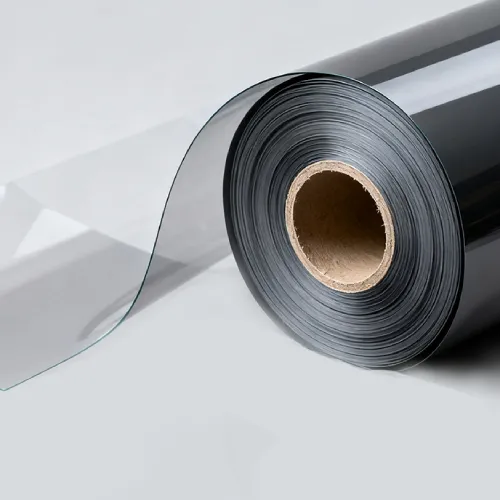
Long-lasting performance — protection doesn’t wash off
Cost-effective solution for high-volume production
Excellent thermoforming properties
Good dimensional stability
Suitable for both PS and PP base materials
Technology: Internal additive method
Anti-static agents are permanently incorporated into the polymer matrix during extrusion, providing consistent and long-lasting ESD protection through continuous migration to the surface.
Recommended Specs: 0.3–0.6 mm
Storage environment affects performance — temperature, humidity, and dimensional control recommended
Crystal-clear transparency — no impact on optical clarity
Immediate ESD protection upon application
Compatible with printing and secondary processing
Lower cost than internal anti-static solutions
Excellent surface smoothness
Technology: External coating method
Anti-static coating is applied to the PET surface through precision coating equipment, creating an immediate dissipative layer while maintaining maximum clarity.
Limitations to Note
⚠ Anti-static effect may diminish over time with heavy handling
⚠ Best suited for products with defined shelf life
Superior and permanent ESD protection — best-in-class performance
Volume conductivity ensures protection even if surface is scratched
Extremely stable performance across temperature and humidity
Does not rely on moisture for conductivity
Washable and reusable — protection won’t diminish
Technology: Intrinsic anti-static method
Conductive materials are molecularly integrated into the PET polymer structure, creating volume resistivity (not just surface) for superior and permanent ESD protection.
Trade-off Considerations
⚠ Slightly reduced clarity compared to virgin PET (typically 80-85% light transmission)
⚠ Higher cost than topical coating solutions
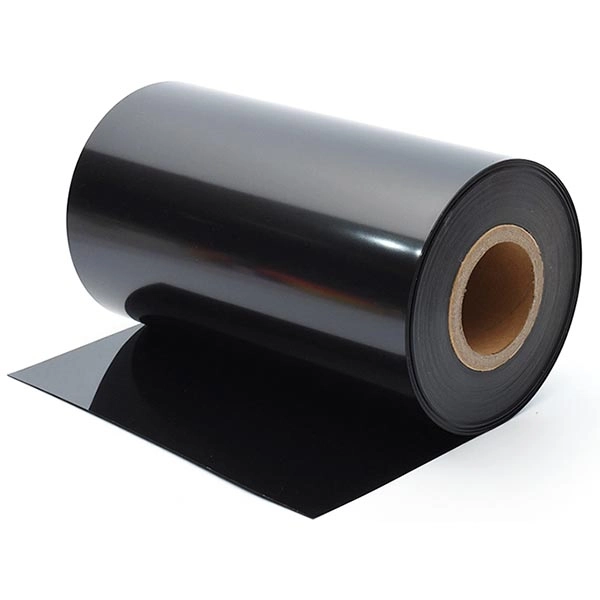
PS/PP Surface or Volume Conductive Sheet (Carbon Black)
Black only (due to carbon black content) | Matte or semi-gloss | Fully opaque
Exceptionally stable resistivity — unaffected by environmental conditions
Consistent performance across complex cavity geometries
Resistivity unaffected by tray depth or wall thickness variations
Highest level of ESD protection for ultra-sensitive components
Customizable to exact customer resistivity requirements
Technology: Carbon black conductive filler technology
High-purity carbon black particles are uniformly dispersed throughout the polymer matrix, creating continuous electron pathways for stable and permanent conductivity. The carbon black network ensures consistent volume resistivity regardless of surface conditions.
Advanced conductive polymer molecules are chemically bonded into the base polymer structure, creating a permanent three-dimensional conductive network. Unlike migratory additives, this technology provides stable resistivity independent of cavity complexity or forming depth.
Recommended Specs: 0.4–0.8 mm
Comparison with Carbon Black Solution
Feature
Carbon Black
Polymer Anti-static
Resistivity Stability
Excellent
Excellent
Color Options
Black only
Natural / White
Cavity Complexity Effect
Minimal
Minimal
Cost
Lower
Moderate
Aesthetics
Industrial
Premium
Our Manufacturing Strengths
Proprietary polymer formulation developed in-house
Guaranteed post-forming resistivity: 10⁷–10⁹Ω
Validated performance at extreme draw ratios (up to 2:1)
Rapid turnaround — coating can be adjusted for specific orders
Technology: PEDOT:PSS conductive polymer coating
PEDOT:PSS (poly(3,4-ethylenedioxythiophene) polystyrene sulfonate) is a high-performance transparent conductive polymer coating applied to PET surface. This advanced material allows precise control of surface resistivity across a wide range while maintaining excellent optical clarity.
Limitations to Note:
⚠ PEDOT:PSS coating may be affected by prolonged exposure to high humidity
⚠ Coating durability lower than internal anti-static solutions
⚠ Best suited for applications with controlled storage environment
Ultra-fine carbon nanotubes form a transparent conductive network on PET surface. The unique one-dimensional structure of CNTs creates highly efficient electron pathways, enabling excellent conductivity with minimal material usage. This results in superior coating stability and minimal resistivity change after thermoforming.
Performance Specs: Sheet Resistivity: 10⁴ – 10⁷ Ω (Customizable) Post-Forming Resistivity: Only 1 log increase from sheet value Resistivity Stability After Forming: Resistivity Stability After Forming Static Decay Time < 0.05 seconds (at 10⁵Ω) Coating Durability: 12-24 months (better than PEDOT:PSS)
Comparison with PEDOT:PSS
Feature
PEDOT:PSS
Carbon Nanotube
Resistivity Range
10⁴-10⁹Ω
10⁴-10⁷Ω
Transparency
Excellent
Very Good
Forming Stability
Moderate
Excellent
Durability
Good
Excellent
Cost
Lower
Moderate
Best For
Wide range applications
Precision applications
Our Manufacturing Strengths
Advanced CNT dispersion technology — uniform nanotube distribution
Proprietary coating formulation optimized for thermoforming stability
Pre-production tray testing available to validate final resistivity
Guaranteed forming stability: resistivity change documented and certified
Quality control: sheet and formed tray resistivity both tested