Principaux produits
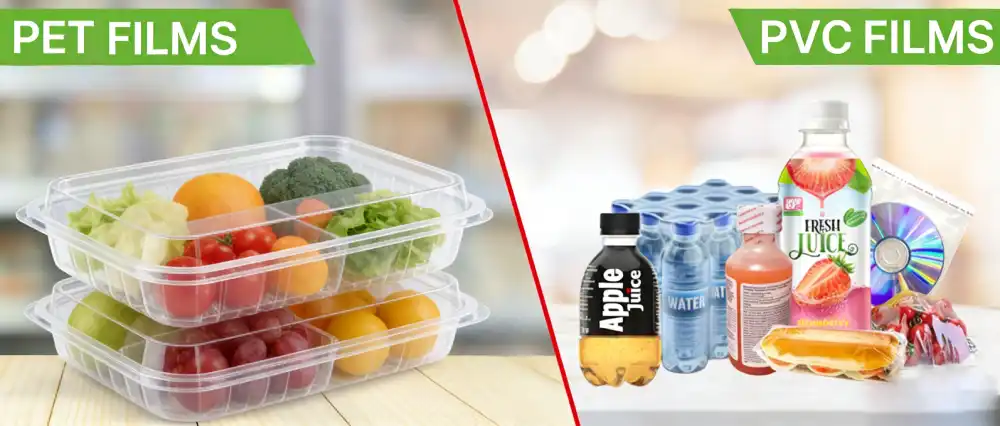
(Thermoforming Sheet for Food Trays & Clamshells — Not Injection Containers or Films)
If you are sourcing rigid thermoforming sheet to produce food trays, clamshell boxes, or fresh produce containers, PET sheet is the safer, more compliant, and more sustainable long-term choice.
PVC thermoforming sheet still exists in certain low-cost or legacy applications, but for direct food contact packaging, especially in export markets (US, EU, Japan), PET is overwhelmingly preferred due to:
From a procurement perspective, PVC may appear slightly cheaper per kg, but when factoring in compliance risk, recycling pressure, and customer requirements, PET typically delivers lower long-term risk and higher market acceptance.
This article reflects 10+ years of hands-on experience supplying thermoforming sheet to food packaging manufacturers across North America, Europe, and Southeast Asia.
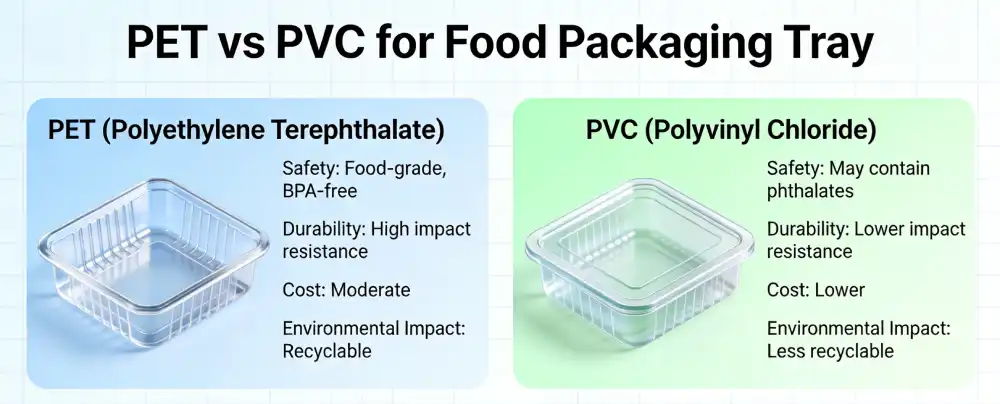
This comparison specifically covers:
That distinction matters because processing, compliance, and cost structure differ significantly.
| Facteur | PET Sheet (APET / RPET) | PVC Sheet (Rigid PVC) |
|---|---|---|
| Conformité au contact alimentaire | Widely approved (FDA, EU 10/2011) | Allowed but under more scrutiny |
| Chemical Structure | Polyester (no chlorine) | Contains chlorine (PVC = polyvinyl chloride) |
| Recyclabalité | Highly recyclable (#1 stream) | Limited recycling infrastructure |
| Clarté optique | Excellent, glass-like | Good, slight bluish tone |
| Densité | ~1.33–1.38 g/cm³ | ~1.38–1.45 g/cm³ |
| Odor | Neutre | Slight odor at high temperature |
| Processing Temperature | ~120–160°C forming range | ~140–180°C |
| Heat Stability | Stable | Risk of HCl release at overheating |
| Sustainability Perception | Strong | Weak in Western markets |
| Typical Cost | Slightly higher per kg | Slightly lower per kg |
PET used in thermoforming sheet is widely compliant with:
It does not contain chlorine or plasticizers in rigid sheet form.
For direct contact with fresh foods like:
PET has become the dominant choice globally.
PVC itself can be food contact compliant. However:
In my experience, European buyers increasingly reject PVC packaging outright for fresh food applications.
Large retailers in markets like Germany, France, and Scandinavia have already phased it out.
If you export food packaging products, sustainability is no longer optional.
For brands seeking ESG reporting compliance, PET is significantly easier to justify.
PET provides superior clarity and gloss.
For retail display packaging, especially:
PET gives a premium appearance that supports price positioning.
PVC clarity is good, but PET generally offers better brilliance and transparency.
PET thermoforming sheet offers:
Le PVC vient :
For high-speed automated thermoforming lines, PET is generally more forgiving.
PVC is often 3–8% cheaper per kg compared to virgin PET in some markets.
However, total cost should include:
Many buyers who initially switch to PVC for cost reasons eventually return to PET due to downstream pressure from clients.
In B2B packaging supply chains, risk cost is often higher than raw material savings.
However, long-term trend strongly favors PET.
When choosing between PET and PVC thermoforming sheet, evaluate:
US/EU = PET preferred
Developing domestic market = cost-driven decision possible
Premium retail = PET
Low-end commodity packaging = PVC possible
If customer requests recyclable packaging → PET only
PVC faces increasing global pressure.
From a strategic procurement standpoint, PET offers future-proofing.
Over the past decade:
Several global supermarket groups now require recyclable mono-material packaging — PET fits this requirement, PVC does not.
Rigid PVC can meet food contact standards, but it faces increasing environmental and regulatory scrutiny compared to PET.
Because PET has an established recycling stream (#1 resin code) and can incorporate recycled content easily.
Slightly, but lifecycle cost and compliance benefits often outweigh raw material price difference.
PET is strongly recommended due to food safety perception, clarity, and export compliance.
If processed properly, no. However, overheating during thermoforming can cause odor issues.
From over a decade of supplying thermoforming sheet for food packaging:
If your business supplies retail food packaging, exports products, or works with regulated markets, PET is the professional and future-proof choice.
PVC remains a cost-driven alternative in limited scenarios, but its global acceptance is declining.
For serious packaging manufacturers focused on long-term growth, PET thermoforming sheet is the strategic material.
Suivez-nous


Informations de contact:
No.32 Lubin Rd, zone industrielle Lucky, Shanghai, Shanghai, Chine Téléphone:+8613818585204 E-mail:[email protected]Cliquez pour discuter sur WhatsApp

Produits